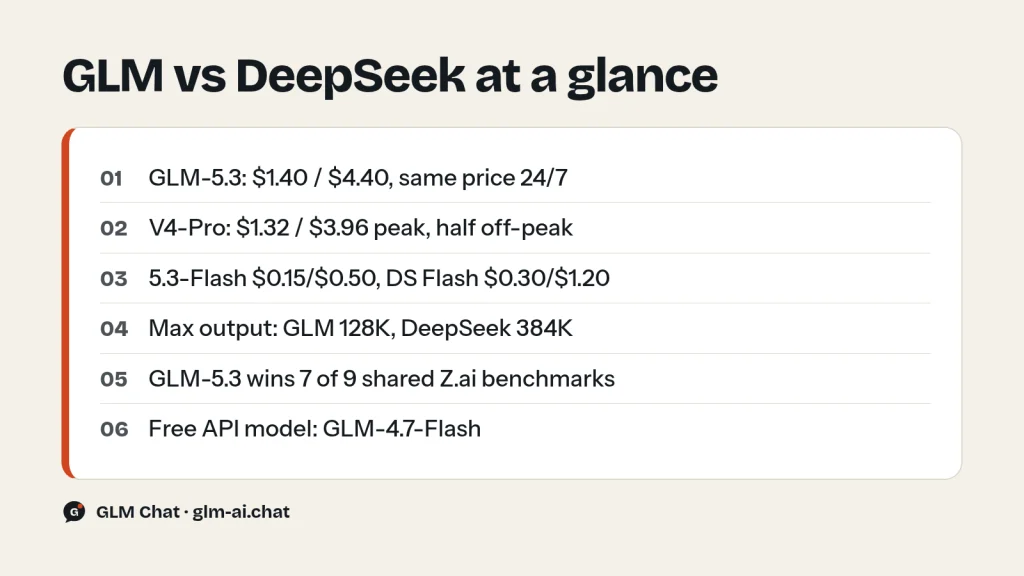
GLM vs DeepSeek, short answer: pick GLM-5.3 for agentic coding and tool use, and DeepSeek for the lowest token bill. In Z.ai’s published benchmark table, GLM-5.3 beats DeepSeek-V4-Pro-0813 on seven of the nine tests where both have a score, including DeepSWE (66.9 vs 62.7) and AutomationBench (48.2 vs 43.2). DeepSeek’s API costs less per token, drops to half price off-peak, and allows up to 384K output tokens per reply, three times GLM’s 128K.
Beyond the headline, the two differ in ways that matter day to day. GLM has a model that is truly free on the API (GLM-4.7-Flash), a flat-rate Coding Plan for tools like Claude Code, and a cheap multimodal model that takes video and files. DeepSeek offers a single, simpler price list with a large off-peak discount, native Anthropic-format endpoints for everyone, and a public API status page at status.deepseek.com. This guide compares both on price, specs, benchmarks, coding workflows and weights, then gives a clear verdict.
GLM vs DeepSeek at a glance
Z.ai (formerly Zhipu AI) makes GLM, and its current line-up is GLM-5.3 (flagship) and GLM-5.3-Flash (cheap and multimodal). DeepSeek’s API offers two models: deepseek-v4-pro, which runs DeepSeek-V4-Pro-0813, and deepseek-flash, which runs DeepSeek-V4.1-Flash. The flagships face each other, and so do the budget models.
| Compared | GLM (Z.ai) | DeepSeek |
|---|---|---|
| Flagship API model | glm-5.3 | deepseek-v4-pro |
| Budget API model | glm-5.3-flash | deepseek-flash |
| Flagship price (in / out per 1M) | $1.40 / $4.40 | $1.32 / $3.96 peak, $0.66 / $1.98 off-peak |
| Budget price (in / out per 1M) | $0.15 / $0.50 | $0.30 / $1.20 peak, $0.15 / $0.60 off-peak |
| Free API model | GLM-4.7-Flash, GLM-4.5-Flash, GLM-4.6V-Flash | None listed on the pricing page |
| Context window | 1M | 1M |
| Max output | 128K | 384K |
| Image input | GLM-5.3-Flash (plus video and files) | deepseek-flash only |
| Coding subscription | GLM Coding Plan from $18/month | None on the pricing page |
| Open weights | Yes (MIT; GLM-5.3 License for GLM-5.3) | Yes (DeepSeek-V4 series on Hugging Face) |
| Public status page | No | Yes, linked from the API docs |
Price: GLM vs DeepSeek API costs
Both providers bill per million tokens, with a much lower rate for input that hits the cache. The structures differ in one important way. Z.ai charges one price around the clock. DeepSeek has a peak rate and an off-peak rate at exactly half of it. DeepSeek’s peak hours are 01:00 to 04:00 and 06:00 to 10:00 UTC on weekdays; all other hours are off-peak, including weekends.
| Model | Input | Cached input | Output |
|---|---|---|---|
| GLM-5.3 | $1.40 | $0.26 | $4.40 |
| GLM-5.2 | $1.40 | $0.26 | $4.40 |
| GLM-5.3-Flash | $0.15 | $0.03 | $0.50 |
| GLM-5.3-FlashX | $0.37 | $0.075 | $1.25 |
| GLM-4.7-Flash | Free | Free | Free |
| deepseek-v4-pro (peak) | $1.32 | $0.044 | $3.96 |
| deepseek-v4-pro (off-peak) | $0.66 | $0.022 | $1.98 |
| deepseek-flash (peak) | $0.30 | $0.006 | $1.20 |
| deepseek-flash (off-peak) | $0.15 | $0.003 | $0.60 |
Three things stand out. First, at peak the flagships cost almost the same: DeepSeek-V4-Pro is about 6% cheaper on input and 10% cheaper on output than GLM-5.3. Off-peak, it costs less than half. Second, GLM-5.3-Flash undercuts deepseek-flash at peak ($0.15 vs $0.30 input, $0.50 vs $1.20 output). Off-peak, the input prices match and GLM-5.3-Flash is still cheaper on output. Third, DeepSeek’s cached input is far cheaper: $0.044 against GLM-5.3’s $0.26. Workloads that resend the same long context, such as agents and RAG over a fixed corpus, benefit most from that.
Worked example: 10M input and 1M output tokens
Take a month of moderate API use: 10 million input tokens and 1 million output tokens. Scenario A has no cache hits. Scenario B has 8M of the 10M input tokens served from cache, which is typical for an agent that resends the same repository context.
| Model | A: no cache | B: 80% cached |
|---|---|---|
| GLM-5.3 | $18.40 | $9.28 |
| deepseek-v4-pro, peak | $17.16 | $6.95 |
| deepseek-v4-pro, off-peak | $8.58 | $3.48 |
| GLM-5.3-Flash | $2.00 | $1.04 |
| deepseek-flash, peak | $4.20 | $1.85 |
| deepseek-flash, off-peak | $2.10 | $0.92 |
| GLM-4.7-Flash | $0 | $0 |
How the numbers are built: GLM-5.3 in scenario A is 10 × $1.40 + 1 × $4.40 = $18.40. In scenario B it is 2 × $1.40 + 8 × $0.26 + 1 × $4.40 = $2.80 + $2.08 + $4.40 = $9.28. deepseek-v4-pro at peak in scenario B is 2 × $1.32 + 8 × $0.044 + 1 × $3.96 = $2.64 + $0.35 + $3.96 = $6.95. Every off-peak figure is half of its peak figure.
Keep two caveats in mind. The two providers use different tokenizers, so the same text is not exactly the same number of tokens on each. And thinking models bill their reasoning as output tokens, so the effort level you choose can move the bill more than the price list does. On GLM-5.3, reasoning_effort: "low" is the cheapest setting; the GLM thinking mode guide explains the trade-off. For every GLM price, including vision and image models, see the GLM pricing page. For how GLM’s cache works, see GLM context caching.
Free ways to use each
GLM has more free routes. GLM-4.7-Flash, GLM-4.5-Flash and GLM-4.6V-Flash are free on the Z.ai API, with limits set by your account’s rate limits. Z.ai’s chat app at chat.z.ai is free. OpenRouter lists a free variant, z-ai/glm-5.2:free, with a 32K context. You can also use the free GLM chat on this site with no sign-up. DeepSeek’s pricing page lists no free model; costs are deducted from a topped-up or granted balance.
Specs and features compared
| Feature | GLM-5.3 | GLM-5.3-Flash | deepseek-v4-pro | deepseek-flash |
|---|---|---|---|---|
| Context | 1M | 1M | 1M | 1M |
| Max output | 128K | 128K | 384K | 384K |
| Input types | Text | Video, image, text, file | Text | Text, vision |
| Parameters | 744B total, 40B active | 320B total, 18B active | — | — |
| Thinking | Always on (low, high, max) | Always on (low, high, max) | Thinking (default) or non-thinking | Thinking (default) or non-thinking |
| JSON output | Yes | Not listed | Yes | Yes |
| Tool calls | Yes, with tool_stream | Yes | Yes | Yes |
| OpenAI-format API | Yes | Yes | Yes | Yes |
| Anthropic-format API | Coding Plan endpoint | Coding Plan endpoint | Yes | Yes |
| Responses API | Base api.z.ai/api/v1 | — | Yes | Yes |
| Rate limits | Per account and model, in console | Same | 500 concurrent | 2,500 concurrent |
The practical differences come down to four points:
- Thinking control. DeepSeek lets you switch thinking off entirely. GLM-5.3 and GLM-5.3-Flash always think; the lightest option is
reasoning_effort: "low". If you need instant, reasoning-free replies from a GLM model, use GLM-5.2 with effortnone, or GLM-4.7-Flash with thinking disabled. - Long outputs. DeepSeek’s 384K output ceiling suits huge single-shot generations such as full translations, long reports or big code files. GLM caps output at 128K, which is still plenty for most agent turns.
- Multimodal input. GLM-5.3-Flash is the first natively multimodal GLM-5 model and accepts video, images, text and files. deepseek-flash supports vision; deepseek-v4-pro does not.
- Extras. DeepSeek offers chat prefix completion and FIM completion in beta (FIM in non-thinking mode only). Z.ai offers a built-in web search tool at $0.01 per use and image generation with GLM-Image at $0.015 per image.
GLM vs DeepSeek benchmarks (Z.ai-reported)
All benchmark numbers below come from Z.ai’s own tables in its GLM-5.3 and GLM-5.2 announcements. Z.ai ran the comparison models itself, under its own settings. Use them for direction, not decimal-point precision.
GLM-5.3 vs DeepSeek-V4-Pro-0813
DeepSeek-V4-Pro-0813 is the version behind today’s deepseek-v4-pro API model, so this is the current flagship matchup.
| Benchmark | GLM-5.3 | GLM-5.2 | DeepSeek-V4-Pro-0813 |
|---|---|---|---|
| Terminal Bench 2.1 | 88.2 | 81.0 | 87.9 |
| DeepSWE v1.1 | 66.9 | 46.2 | 62.7 |
| NL2Repo | 58.0 | 48.9 | 61.1 |
| CyberGym | 84.5 | 77.2 | 83.3 |
| Toolathlon Verified | 73.0 | 59.9 | 74.1 |
| AutomationBench v1.0.6 | 48.2 | 26.2 | 43.2 |
| Agents’ Last Exam (ALE-CLI) | 28.5 | 23.8 | 25.7 |
| HLE with tools | 62.5 | 54.7 | 60.0 |
| GDPval-AA v2 | 1769 | 1508 | 1590 |
GLM-5.3 leads on seven of these nine rows. The margins are wide on AutomationBench (+5.0), DeepSWE (+4.2) and GDPval-AA (+179), and narrow on Terminal Bench 2.1 (+0.3). DeepSeek-V4-Pro-0813 wins NL2Repo (61.1 vs 58.0), which builds a whole repository from a natural-language spec, and Toolathlon Verified (74.1 vs 73.0). On the benchmarks Z.ai highlights for GLM-5.3, such as Terminal Bench 3.0, ProgramBench and SWE-Marathon, the table has no DeepSeek score.
GLM 5.2 vs DeepSeek: the honest picture
Searches for “GLM 5.2 vs DeepSeek” usually mean the June 2026 matchup. In the GLM-5.2 announcement, Z.ai compared it with an earlier DeepSeek-V4-Pro, and GLM-5.2 won 13 of 16 rows:
| Benchmark | GLM-5.2 | DeepSeek-V4-Pro |
|---|---|---|
| HLE | 40.5 | 37.7 |
| HLE with tools | 54.7 | 48.2 |
| CritPt | 20.9 | 12.9 |
| AIME 2026 | 99.2 | 94.6 |
| HMMT Nov 2025 | 94.4 | 94.4 |
| HMMT Feb 2026 | 92.5 | 95.2 |
| IMOAnswerBench | 91.0 | 89.8 |
| GPQA-Diamond | 91.2 | 90.1 |
| SWE-bench Pro | 62.1 | 55.4 |
| NL2Repo | 48.9 | 35.5 |
| DeepSWE | 46.2 | 8.0 |
| ProgramBench | 63.7 | 47.8 |
| Terminal Bench 2.1 (Terminus-2) | 81.0 | 64.0 |
| FrontierSWE | 74.4 | 29.0 |
| MCP-Atlas (public set) | 76.8 | 73.6 |
| Tool-Decathlon | 48.2 | 52.8 |
Now compare that with the first table. Two months later, in Z.ai’s GLM-5.3 table, DeepSeek-V4-Pro-0813 scores higher than GLM-5.2 on all nine shared rows. On Terminal Bench 2.1, for example, it scores 87.9 to GLM-5.2’s 81.0, and on DeepSWE 62.7 to 46.2. The two announcements used different benchmark versions and settings, so don’t subtract numbers across tables. The direction is still clear: against today’s DeepSeek, GLM-5.2 is behind, and GLM-5.3 is the GLM model to compare. On Z.ai’s API both cost the same ($1.40 / $4.40), so there is little reason to choose GLM-5.2 over GLM-5.3 for new work. The exceptions are needing its MIT license or its option to skip thinking.
Coding: agents, Claude Code and coding plans
Both providers target coding agents, but they sell access differently. For many developers this, more than any benchmark, decides DeepSeek vs GLM: do you want to pay per token or per month?
GLM offers a subscription on top of the API. The GLM Coding Plan costs $18 (Lite), $80 (Pro) or $168 (Max) a month, with 20% off quarterly and 30% off yearly billing. It gives credit-based access to GLM-5.3 and GLM-5.3-Flash inside supported tools: ZCode, AutoClaw, Claude Code, Codex, Cursor, OpenCode, OpenClaw, Cline, Kilo Code, Roo Code and others. GLM-5.3-Flash gets three times the quota of GLM-5.3. Off-peak use costs half the credits. Plan peak hours are 14:00 to 18:00 UTC+8 on weekdays, which is 06:00 to 10:00 UTC, the same window as part of DeepSeek’s peak. From September 25 to October 7, 2026, Z.ai bills every hour at the off-peak rate. Z.ai claims savings of up to 92% against pay-as-you-go GLM-5.3 API prices.
DeepSeek lists only pay-as-you-go token prices on its pricing page. Its docs include integration guides for coding agents such as Claude Code, Codex, OpenCode, OpenClaw, WorkBuddy/CodeBuddy and Qoder, and it exposes an Anthropic-format endpoint at https://api.deepseek.com/anthropic for every account. Heavy agent users pay per token, and the off-peak discount is how they save.
Which is cheaper for coding depends on volume. For a light, steady workload, DeepSeek’s off-peak token prices are hard to beat. For heavy daily agent sessions, the Coding Plan’s flat price is usually better value. Z.ai estimates the Lite tier at 48 to 97 million GLM-5.3 tokens a week at a 95% cache-hit rate, and 146 to 292 million with GLM-5.3-Flash. To set GLM up in Claude Code, follow how to use GLM in Claude Code.
Open weights and self-hosting
Both families publish weights on Hugging Face, so both can be self-hosted. They differ in the details.
- GLM-5.2, GLM-5.1, GLM-5, GLM-5.3-Flash and GLM-4.7-Flash use the MIT license. You can use, modify, fine-tune and sell with no extra conditions.
- GLM-5.3 uses the custom GLM-5.3 License. It gives MIT-style permissions plus one condition: a “Model as a Service” business with more than $10 billion in revenue over any 12 months must pass Z.ai’s security review before commercial use. That condition does not affect almost anyone else.
- DeepSeek-V4 series weights are published on Hugging Face. Check the license on each model card before commercial deployment.
For local use on modest hardware, the GLM side has a clear small option. GLM-4.7-Flash is a 30B-A3B MoE model that runs with vLLM and SGLang, and it is the most-downloaded GLM repository on Hugging Face. The flagships on both sides are large MoE models that need multi-GPU servers. GLM-5.3 and GLM-5.2 have 744B total parameters, so the weights alone take roughly 744 GB in FP8 (one byte per parameter), before KV cache. The license details are in Is GLM open source?
Our test results
Here is how the GLM models handle GLM Chat’s five standard tasks. Every model runs three times through the same five fixed prompts, with the same settings as the public chat: temperature 0.7, a maximum of 2,048 output tokens and the lightest reasoning setting available. An editor scores each answer from 0 to 2, for a maximum of 10 per model.
- Python: a function that removes duplicate rows from a large CSV file. It must stream row by row with the csv module, keep the header, support key columns and keep the first occurrence. This task shows whether a model respects memory constraints.
- JavaScript: a
debounce(fn, wait, { leading, trailing })function withcancel(), plus unit tests that pass undernode --test. This task tests edge cases, especially leading and trailing together. - PHP refactor: a messy 60-line function becomes clean PHP 8 with identical behaviour for all three order types, escaped output and parameterised SQL. This task shows whether a model can change code safely.
- Explanation: transformer attention for a complete beginner in about 150 words. The answer must be technically accurate (queries, keys, values, weights) and between 120 and 180 words.
- Extraction: a messy product description turned into valid JSON with exact keys, units converted to centimetres and
nullfor the missing field. This task reveals whether a model invents data.
A score of 2 means correct and complete. A 1 means usable after a small fix. A 0 means wrong, broken or invented. The table shows each model’s score per task, the total and the date the battery ran.
Our test results
| Model | Task 1 | Task 2 | Task 3 | Task 4 | Task 5 | Total /10 | Avg latency | Why (across runs) |
|---|---|---|---|---|---|---|---|---|
| GLM-5.3 | 2 | 2 | 1 | 1 | 1 | 7 | 7.6 s | Task 3: output not escaped (2/3 runs) · Task 4: no queries/keys/values (2/3 runs) · +1 more |
| GLM-5.3-Flash | 2 | 0 | 1 | 2 | 2 | 7 | 12.9 s | Task 2: fails our debounce behaviour checks (2/3 runs) · Task 3: output not escaped (3/3 runs) |
| GLM-5.2 | 2 | 1 | 1 | 1 | 2 | 7 | 6.6 s | Task 2: its own tests fail (2/3 runs) · Task 3: output not escaped (3/3 runs) · +1 more |
| GLM-5.1 | 2 | 2 | 1 | 1 | 2 | 8 | 14.3 s | Task 3: output not escaped (3/3 runs) · Task 4: no queries/keys/values (2/3 runs) |
| GLM-4.7 | 2 | 1 | 1 | 2 | 2 | 8 | 14.4 s | Task 2: fails our debounce behaviour checks (1/3 runs) · Task 3: output not escaped (3/3 runs) |
| GLM-4.7-Flash | 2 | 0 | 0 | 1 | 1 | 4 | 38.5 s | Task 2: fails our debounce behaviour checks (2/3 runs) · Task 3: changes the function’s behaviour (3/3 runs) · +2 more |
To put DeepSeek on the same scale, send the same five prompts, three times each, to deepseek-v4-pro or deepseek-flash with temperature 0.7 and a 2,048-token output cap, then score them with the rubric above. Watch tasks 2 and 5 most closely. The debounce tests reveal whether a model handles subtle timing states. The extraction task reveals whether it fills gaps with invented values instead of null. The editorial policy has the full rubric, and you can run the GLM side yourself in the free GLM-5.3 chat.
Switching between GLM and DeepSeek in code
Both APIs speak the OpenAI Chat Completions format, so one client can call either by changing the base URL, key and model name. That makes A/B testing cheap. Route a slice of traffic to each and compare quality and cost on your own prompts.
import os
from openai import OpenAI

PROVIDERS = {
    "glm": {
        "base_url": "https://api.z.ai/api/paas/v4/",
        "key_env": "ZAI_API_KEY",
        "model": "glm-5.3",
    },
    "deepseek": {
        "base_url": "https://api.deepseek.com",
        "key_env": "DEEPSEEK_API_KEY",
        "model": "deepseek-v4-pro",
    },
}

def ask(provider: str, prompt: str) -> str:
    cfg = PROVIDERS[provider]
    client = OpenAI(api_key=os.environ[cfg["key_env"]], base_url=cfg["base_url"])
    extra = {"reasoning_effort": "low"} if provider == "glm" else {}
    resp = client.chat.completions.create(
        model=cfg["model"],
        messages=[{"role": "user", "content": prompt}],
        **extra,
    )
    return resp.choices[0].message.content

print(ask("glm", "Explain a Python generator in two sentences."))
print(ask("deepseek", "Explain a Python generator in two sentences."))
Watch for these GLM-specific details when porting code. Keep temperature between 0.0 and 1.0. Never send "thinking": {"type": "disabled"} to glm-5.3, because the request fails; use effort low instead. Read reasoning from reasoning_content and the answer from content when streaming. The GLM API quickstart covers keys, streaming and SDKs in full.
GLM vs DeepSeek FAQ
Is GLM better than DeepSeek?
For agentic coding and tool use, GLM-5.3 comes out ahead in Z.ai’s published results: it leads DeepSeek-V4-Pro-0813 on seven of nine shared benchmarks. DeepSeek wins on NL2Repo, on Toolathlon, on price per token (especially off-peak) and on maximum output length.
Is DeepSeek cheaper than GLM?
At the flagship tier, yes: deepseek-v4-pro costs $1.32 / $3.96 at peak and half that off-peak, against GLM-5.3’s flat $1.40 / $4.40. At the budget tier, GLM-5.3-Flash ($0.15 / $0.50) is cheaper than deepseek-flash at peak and cheaper on output even off-peak. GLM-4.7-Flash is free.
Which is better, GLM-5.2 or DeepSeek?
GLM-5.2 beat the earlier DeepSeek-V4-Pro in Z.ai’s June table, but the current DeepSeek-V4-Pro-0813 scores higher than GLM-5.2 on every shared row in Z.ai’s newer GLM-5.3 table. Compare DeepSeek with GLM-5.3 instead. It costs the same as GLM-5.2 on Z.ai’s API.
Are GLM and DeepSeek open source?
Both publish open weights. Most GLM models use the MIT license. GLM-5.3 uses the GLM-5.3 License, which is MIT-style with one condition for very large model-hosting businesses. DeepSeek publishes its V4 series on Hugging Face; check each model card for the license terms.
Can I use GLM or DeepSeek in Claude Code?
Yes, both. GLM connects through the Coding Plan’s Anthropic-compatible endpoint, https://api.z.ai/api/anthropic, billed from your plan credits. DeepSeek connects through https://api.deepseek.com/anthropic and is billed per token.
Which has the bigger context window?
Neither. GLM-5.3, GLM-5.3-Flash and both DeepSeek models all accept 1M tokens of context. DeepSeek allows longer replies: up to 384K output tokens against GLM’s 128K.
Does DeepSeek have a free API model like GLM-4.7-Flash?
DeepSeek’s pricing page lists no free model; usage is deducted from a topped-up or granted balance. Z.ai’s GLM-4.7-Flash, GLM-4.5-Flash and GLM-4.6V-Flash are free on the API, with limits set by your account’s rate limits.
Pick GLM if… / Pick DeepSeek if…
Pick GLM if…
- You run coding agents all day and want a flat monthly price. The GLM Coding Plan starts at $18 and works in Claude Code, Cursor, Cline and more.
- Agentic coding quality matters most. In Z.ai’s table, GLM-5.3 leads DeepSeek-V4-Pro-0813 on DeepSWE, AutomationBench, Agents’ Last Exam and GDPval-AA.
- You need a truly free API model (GLM-4.7-Flash) or a very cheap one (GLM-5.3-Flash at $0.15 / $0.50).
- Your inputs include video, screenshots or files. GLM-5.3-Flash takes all of them.
- You want MIT-licensed weights to fine-tune and ship, from GLM-4.7-Flash up to GLM-5.2 and GLM-5.3-Flash.
- Your traffic peaks during 01:00 to 04:00 or 06:00 to 10:00 UTC on weekdays, when DeepSeek charges its peak rate and GLM’s price stays the same.
Pick DeepSeek if…
- You process large volumes and can schedule them off-peak, where deepseek-v4-pro costs $0.66 / $1.98.
- Your workload resends the same long context. DeepSeek’s cache-hit price ($0.044 on V4-Pro at peak) is far below GLM-5.3’s $0.26.
- You need single replies longer than 128K tokens, up to 384K.
- You want to switch reasoning off completely on the flagship model.
- You want an Anthropic-format endpoint on plain pay-as-you-go, without a subscription, or you rely on FIM completion.
- Repository generation from a spec (NL2Repo) is your core task. It is one of the two rows DeepSeek-V4-Pro-0813 wins in Z.ai’s table.
Verdict
For most developers choosing between GLM and DeepSeek in 2026, the decision splits by workload. If you build with coding agents, choose GLM. GLM-5.3 posts the stronger agentic numbers in Z.ai’s comparison, the Coding Plan turns heavy use into a fixed monthly cost, and GLM-5.3-Flash plus the free GLM-4.7-Flash cover the cheap end better than any DeepSeek option at peak. If you run high-volume API jobs that can wait for off-peak hours, choose DeepSeek. Half-price off-peak tokens and very cheap cache hits make it the lower bill for batch work.
Because both speak the OpenAI format, you don’t have to commit. Wire up both, send the same prompts and keep the one that wins on your data. Start the GLM side now in the free GLM chat, or see how GLM compares with Anthropic’s models in GLM vs Claude.